
FOOD For the Poor (FFP) Guyana Inc. remains focused on building partnerships and fostering collaboration in an effort to contribute to the development of Guyana.
For 2026, their goal is to partner with not only the private sector, but also the government, and other non-governmental organisations to meaningfully impact Guyanese through its various programmes and initiatives within the country.
For 2025, the non-profit entity advanced its ‘Relief to Resilience’ mandate, by delivering targetted, high-impact interventions that not only supported vulnerable communities, but strengthened local capacities, and contributed to the nation’s long-term development priorities.

CEO of Food For the Poor Guyana, Andrea Benjamin
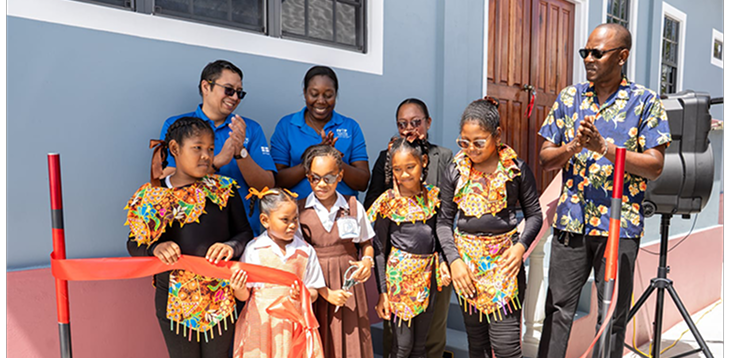
The opening of the Little Red Village Community Centre at Onderneeming, Essequibo Coast, Region Two, which saw the SBM Guyana’s General Manager Martin Cheong and FFP-Guyana’s CEO, Andrea Benjamine, other officials and beneficiaries in attendance
For 2025, the non-profit entity advanced its ‘Relief to Resilience’ mandate, by delivering targetted, high-impact interventions that not only supported vulnerable communities, but strengthened local capacities, and contributed to the nation’s long-term development priorities.
The FFP-Guyana’s work aligns directly with the United Nations Sustainable Development Goals (SDGs), including no poverty, zero hunger, good health and well-being, quality education, reduced inequalities, among several other areas, ensuring that all interventions supported measurable national and global development targets.
Speaking briefly with the Daily Chronicle, Chief Executive Officer of FFP-Guyana, Andrea Benjamin highlighted that for the last three years, the FFP-Guyana’s focus has been on hinterland development, in relation to capacity building. Most of the organisation’s work in this regard is done in Regions One, Two, Four, Six and Seven and there are plans to expand to include Regions Ten and Five.
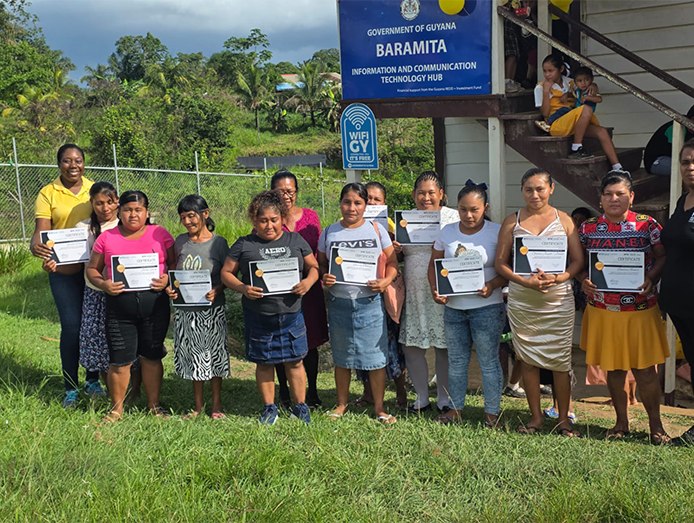
CEO of Food For the Poor Guyana, Andrea Benjamin (left) with participants of the Adult Literacy Programme in Baramita (Photos: FFP-Guyana/Andrea Benjamin)
She noted that regarding relief, which involves the organisation providing necessities such as food, clothing, toiletry among other items, all of Guyana’s regions except Regions Eight and Nine are covered.
According to Benjamin, the FFP is shifting its focus from relief to teaching communities, families and individuals to be resilient, and to learn to be independent.
Throughout the year, FFP‑Guyana implemented major programmatic areas — ranging from education and youth development to community infrastructure, humanitarian relief, health and wellness, social support, livelihoods and skills training, as well as partnership and community networks.
Collectively these programmatic efforts reflected a strategic shift to empowering communities, strengthening local capacity, reducing systemic inequalities, and fostering long-term development, which fully embodied its mandate.
While all efforts to lend support are important, the FFP’s Projects Department executed several targetted, high-impact projects that advanced education, youth empowerment, food security and community resilience in a few regions, all of which were designed to align with national development priorities and the UN’s SDGs.
While all efforts to lend support are important, the FFP’s Projects Department executed several targetted, high-impact projects that advanced education, youth empowerment, food security and community resilience in a few regions, all of which were designed to align with national development priorities and the UN’s SDGs.
One of the most notable projects was the completion of the Lil Red Village Community Centre at Onderneeming, Essequibo Coast, Region Two, which was executed in partnership with the SBM Offshore Guyana for training, youth development, community governance, and social services.
More than 500 youths, children, women and men are set to benefit from activities at the centre, which was officially opened in November 2025.
The FFP’s Quality Education initiative is another project. Introduced in 2024, the Adult Literacy Programme provides women and girls with opportunities to enhance their skills and build capacity. Initially implemented in Baramita, the programme was later expanded to Arakaka, both situated in Region One.
Benjamin explained, “We’re teaching women and girls who did not get the opportunity for whatever reason, to take advantage of the formal education system. So, we’re basically teaching them simple things like writing their names, calculating their date of birth, identifying simple words in their community that will help them navigate within their community. The hospital, the police station, writing the names of their children and spouses, also writing their date of birth,” she added.
The CEO remarked that they embarked on this because they recognised that for these women, it was challenging for them to navigate through life without having these necessary skills.
Calling the lack of this knowledge a barrier to accessing health services and even help in some communities, FFP-Guyana stepped in help women and girls as young as 16 and as old as 62. Community leaders also participated.
In the inaugural batch, thirty women participated, of whom 27 completed the programme and graduated. The second batch recorded 17 graduates, and the third, 15.
Additionally, the organisation conducted its Youth Enhancement Project, equipping 15 vulnerable youths with soft skills, career guidance and psychosocial support, creating pathways to jobs and tertiary education. This was done in partnership with local NGO, the Butterfly Project.